Virtual Reality Across the Employee Lifecycle: Part 1
Virtual Reality Across the Employee Lifecycle: Part 1
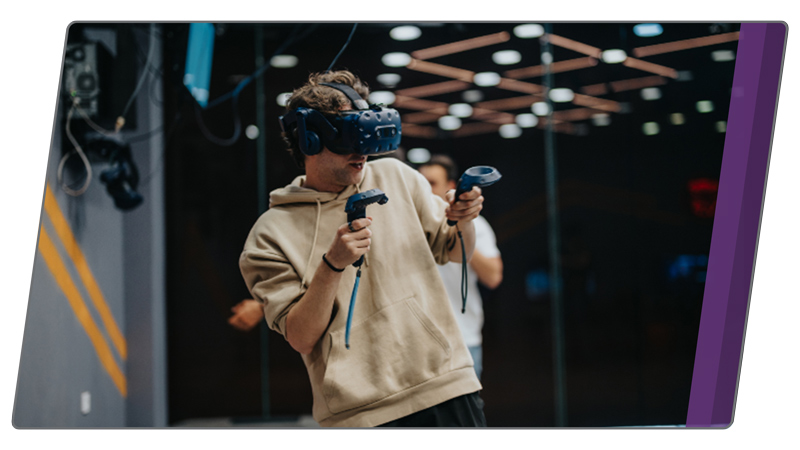
Where VR Creates Value — and Where It Creates Risk — in Recruiting, Selection, and Learning & Development
A practitioner’s guide to optimizing simulation-based assessment and training for dangerous occupations
A Three-Part Series
Part 1: The Readiness Problem & the Recruiting Opportunity
Executive Summary
At what point during the employee lifecycle is it optimal to introduce virtual reality? The answer depends entirely on context. VR’s potential as a workforce tool varies dramatically based on when and how it’s deployed — and the consequences of getting it wrong range from wasted investment to legal liability.
This paper examines the question across three phases: recruiting, selection, and learning and development. The opportunity gradient is clear. In recruiting, VR offers an exciting, low-risk way to attract candidates — provided the experience is polished. In selection, VR-based assessment holds promise for authentic evaluation but introduces significant legal, psychometric, and practical risks. In learning and development, VR finds its natural home — the highest opportunity with the lowest risk.
Threading through all three phases is a single, unifying challenge: Day-1 readiness. Workers in dangerous occupations need extensive, varied practice to build reliable skills. But the work itself is too dangerous for traditional repetition-based learning. Well-designed VR training has enormous potential to resolve this conflict — but only when deployed at the right lifecycle stage, with the right safeguards.
The Day-1 Readiness Problem
Here is the core tension facing every organization that trains people for dangerous work: building reliable skill requires hundreds of practice repetitions in conditions that closely mirror the real environment. But those environments are precisely where practice is dangerous, expensive, or impossible. An EOD technician cannot practice render-safe procedures on live devices hundreds of times. A crane operator cannot rehearse emergency stops with suspended loads over coworkers. A chemical plant technician cannot trigger real emergency shutdowns to build crisis-response muscle memory.
The workforce data makes the stakes concrete. First-year workers face disproportionate injury risk — roughly 40% of workplace injuries occur within an employee’s first twelve months, and analysis of critical safety incidents suggests one in eight injuries happens on Day 1. The problem compounds further: critical procedural skills decay during gaps between assignments, and mixed crews combining experienced operators with newer personnel elevate coordination risk.
Conventional alternatives — classroom lectures, safety videos, shadowing experienced workers on live operations — often provide an abstract preview of the real job’s cognitive and physical demands. Purpose-built VR training can close the gap between the need for safe, repeated practice and the inherent danger of the real environment. But unlocking that potential requires deploying VR at the right point in the lifecycle, with safeguards calibrated to each phase’s specific risks.
Recruiting: The Virtual Job Preview
The Opportunity
VR offers something no brochure or career website can: a genuine experiential preview of what it feels like to do the work. For dangerous occupations — where misconceptions routinely shrink the applicant pool — this matters. A well-designed VR recruiting experience functions as a virtual job tryout. It lets candidates explore both the intriguing and the challenging aspects of the work and self-evaluate their skills and potential fit for the job. This expands the applicant pool, supports better self-selection, reduces early turnover, and signals innovation to younger talent who expect technology-forward workplaces.
The recruiting application also benefits from a critical asymmetry: the stakes are lower than in selection or training. A VR preview isn’t making a hiring decision or certifying dangerous-task competence. It’s creating an experience that helps both sides make a more informed decision about mutual fit. That lower-stakes context gives organizations room to experiment.
The Risks
The primary risk is reputational, not legal. If the VR experience isn’t flawlessly designed — intuitive, user-friendly, optimized for first-time users — it can repel the candidates it’s meant to attract. A clunky interface or disorienting experience will turn someone off about a job before they’ve evaluated the actual work. The recruiting audience has no prior investment in the organization; they’ll simply walk away.
Practical Considerations
Scaling and logistics are real concerns. VR recruiting requires headsets, physical space, and support staff. Organizations must decide whether VR is the sole recruiting modality or one option among several. Alternate modalities reduce logistical burden but dilute the immersive advantage. The key metric: does the investment produce a measurable increase in applicant pool quality, size, or early retention?
Emerging intelligent content generation tools are changing this calculus. The ability to rapidly produce role-specific VR previews could significantly reduce per-scenario costs while maintaining immersive quality. Precision analytics embedded in VR platforms could also capture candidate engagement data during previews — offering richer insight into applicant interest and fit without crossing into formal assessment territory.
Summary
Recruiting represents huge potential with relatively low risk. The requirements: flawless user experience, realistic scaling expectations, and a willingness to measure outcomes rather than assume them.
Get VR Lifecycle White Paper HERE
In Part 2, we turn to the most complex application of VR in the lifecycle: pre-hire selection. The potential for authentic, job-relevant assessment is real — but so are the legal, psychometric, and practical challenges that demand extreme care.