Adaptive Immersion’s New MAVEN Modules Let EOD Technicians See Inside a Live Device — Rehearsing the 4 Decisions a Render-Safe Procedure Turns On
Adaptive Immersion’s New MAVEN Modules Let EOD Technicians See Inside a Live Device — Rehearsing the 4 Decisions a Render-Safe Procedure Turns On
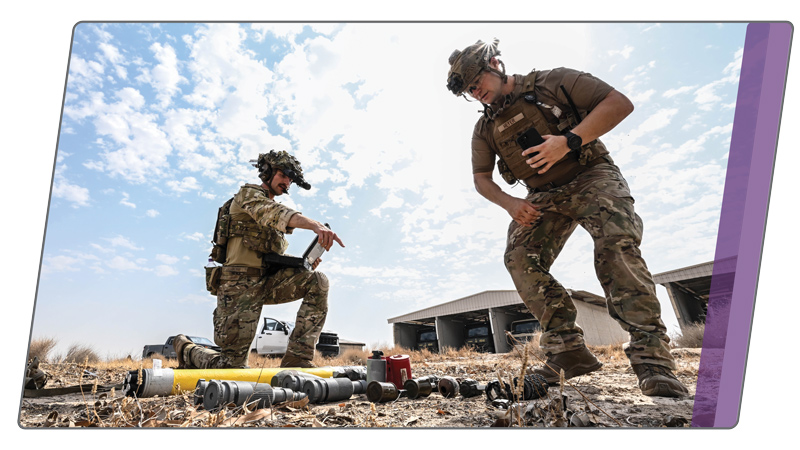
“Inside the Bomb” component-visualization scenarios show technicians the fuzing, charge, and firing train they normally cannot see — so the diagnosis happens in training, not for the first time on the device.
Adaptive Immersion today announced new component-level ordnance-visualization scenarios for MAVEN, its virtual reality training platform for explosive ordnance disposal (EOD) teams. The new content, built around an “Inside the Bomb” view, lets a technician see the internal layout of a device — the fuzing, the main charge, the firing train, and how they connect — while rehearsing the render-safe procedure. The goal is to move the hardest part of the job, the diagnosis under uncertainty, into a place where it can be practiced.
On a real device, a technician cannot see inside. They read the outside, draw on training and reference material, and commit to a render-safe approach with incomplete information. That judgment is the skill that separates a safe outcome from a bad one, and it is the skill that is hardest to build, because the situations that test it are rare, dangerous, and impossible to repeat on demand. A render-safe procedure turns on a small number of decisions — what the device is, how it is meant to function, where the firing train runs, and which approach interrupts it most safely — and each of those decisions is made on inference.
MAVEN’s component-visualization scenarios let an instructor open that device up. A trainee can study the internal configuration, see the consequence of a chosen approach, reset, and try again — building a mental model of how a class of devices behaves before encountering one in the field. The content pairs the visible diagnosis with the stress conditions of the real task: time pressure, ambiguity, and the knowledge that the approach has to be right the first time. That pairing is deliberate. Knowing the components is necessary; making the call under pressure is the part that has to be rehearsed.
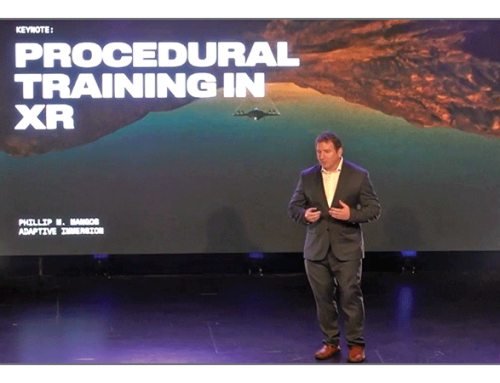
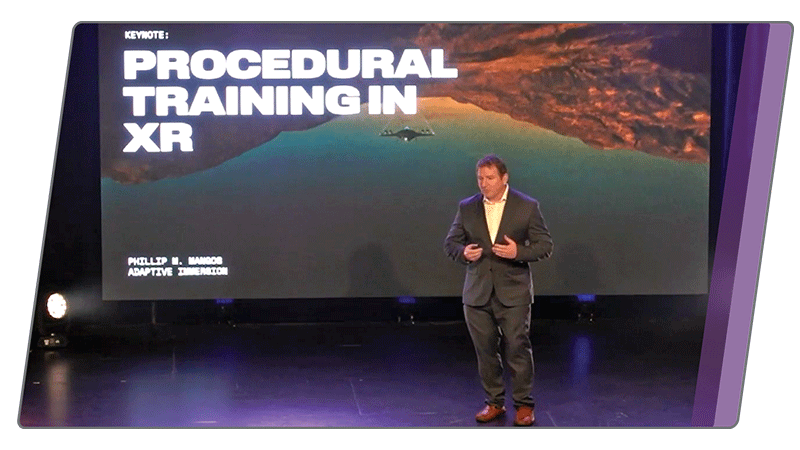
“The hardest moment in render-safe work is the one where you have to decide what you are looking at and how it wants to function — and you have to do it without seeing inside,” said Dr. Phillip M. Mangos, Founder and CEO of Adaptive Immersion. “We can show a technician the inside in training so the reasoning becomes familiar. Then when the device is in front of them and they cannot see in, the diagnosis is not new. They have done it before, many times, where a mistake costs nothing.”
The approach reflects Adaptive Immersion’s Psychological Fidelity pillar: the training problem is rarely that technicians lack technique. It is that the conditions in which the technique has to be applied — the uncertainty, the stress, the one-chance nature of the task — cannot be reproduced in a manual or a slide deck. Component visualization addresses the cognitive half of that problem directly, giving the trainee the mental model, and the stress conditions address the other half, giving the trainee the reps under pressure.
This release continues a body of MAVEN EOD work that has emphasized rehearsing the rarest and hardest situations a technician will face, including aging and expired ordnance that behaves in unexpected ways. Component visualization is the next layer: not only practicing the procedure, but understanding why the procedure works, at the level of the device itself.
The measure of readiness in this field is not how many procedures a technician can recite. It is whether the reasoning holds up the first time the device is real, unfamiliar, and unforgiving. Training that lets a technician build that reasoning in the open — where the device can be opened, paused, and tried again — is one of the few ways to make a first encounter feel like a repeat.