Adaptive Immersion Adds Drone-Delivered Ordnance Render-Safe Scenarios to MAVEN as EOD Teams at 19 Bases Confront a New Class of Threat
Adaptive Immersion Adds Drone-Delivered Ordnance Render-Safe Scenarios to MAVEN as EOD Teams at 19 Bases Confront a New Class of Threat
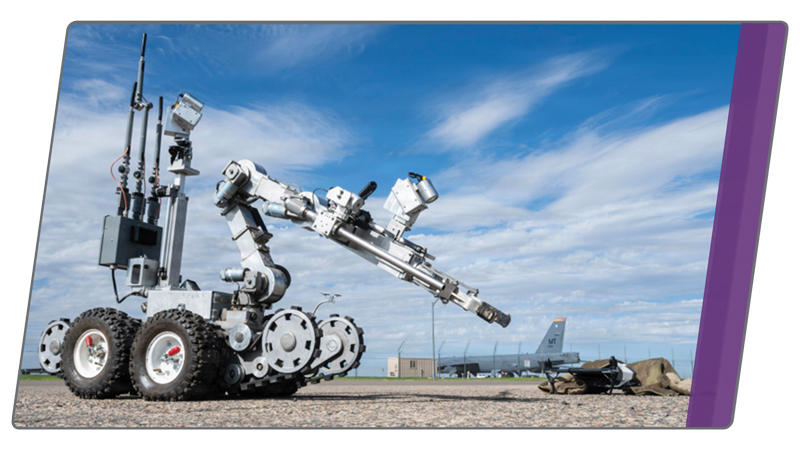
New counter-UAS modules let EOD technicians rehearse the render-safe problem that begins after a loitering munition is grounded — the step kinetic counter-drone training does not cover — built for the joint, multi-domain response the threat now demands.
Adaptive Immersion today announced new counter-unmanned-aircraft-system (counter-UAS) scenario content for MAVEN, its virtual reality training platform for explosive ordnance disposal (EOD) teams. The new modules let technicians rehearse the render-safe procedures required once a drone-delivered munition or loitering munition has been grounded but not yet neutralized — a problem that is becoming routine for EOD units and that classroom instruction and live-fire ranges cannot easily reproduce.
The release responds to a clear shift in how the joint EOD community is training. In reporting published by the U.S. Army, technicians from the Fort Johnson, Louisiana-based 705th Ordnance Company (EOD) — the “Roosters,” part of the 20th CBRNE Command — trained alongside EOD Airmen from Barksdale Air Force Base’s 2nd Civil Engineering Squadron, EOD Flight, specifically to confront and defeat explosive drones. The 20th CBRNE Command fields EOD Soldiers and Army civilians from 19 bases across 16 states, a measure of how widely this mission now reaches.
The unmet training need is narrow but consequential. Much of today’s counter-drone effort focuses on the kinetic engagement — detecting, tracking, and bringing a hostile drone down. The EOD problem begins at the moment that engagement ends. A loitering munition that has been forced down, jammed, or has simply failed to function is still a live explosive hazard, often in an unfamiliar configuration, and often in a place where the first person on scene is not an EOD technician. That render-safe step — approach, diagnosis, and disposal of a grounded drone-delivered munition — is the gap MAVEN’s new content is built to rehearse.
MAVEN lets a technician practice that sequence repeatedly in a consequence-free environment: assessing a grounded munition of uncertain origin, identifying likely fuzing and payload behavior, and working a render-safe approach under time pressure. Because the scenarios are virtual, instructors can present configurations a unit may never see on a live range until it meets one in the field. As 1st Sgt. Brian M. Meroni of the 705th EOD Company put it in the Army’s reporting, “Unmanned Aerial Systems are a multidomain threat and require a multidomain solution.” Training that crosses service and agency lines is part of that solution; so is giving each technician enough repetitions to make the first encounter on the job not the first encounter, period.
“The counter-drone conversation has been almost entirely about taking the drone down. That matters, but it leaves the hardest part untrained,” said Dr. Phillip M. Mangos, Founder and CEO of Adaptive Immersion. “Once a loitering munition is on the ground, you have a live, often unfamiliar explosive problem — and the person who finds it usually is not an EOD tech. We built these scenarios so technicians can rehearse the render-safe step they will actually face, before they face it.”
The content reflects the wider doctrinal direction the EOD community is signaling. New programs aimed at preparing security and first-response personnel for grounded-drone threats, and a loitering-munition proliferation panel held at a June 2026 Army summit, point to the same conclusion the joint EOD units reached on the range: the threat is evolving faster than any single service’s range time can keep up with, and rehearsal frequency is the variable a training program can actually control. Virtual reality is one practical way to close that frequency gap without waiting for the next live exercise window.
Readiness for a threat this new is a moving target. The configurations change, the doctrine is still being written, and the teams that stay ready will be the ones that can rehearse a new situation in days rather than waiting quarters for a course to be rebuilt. That is the standard the joint EOD community is setting for itself, and it is the standard immersive training has to meet.