Adaptive Immersion Brings Multi-Agency Mass-Casualty Response Rehearsal to Venue Digital Twins with MAVEN: RESPONDER
Adaptive Immersion Brings Multi-Agency Mass-Casualty Response Rehearsal to Venue Digital Twins with MAVEN: RESPONDER
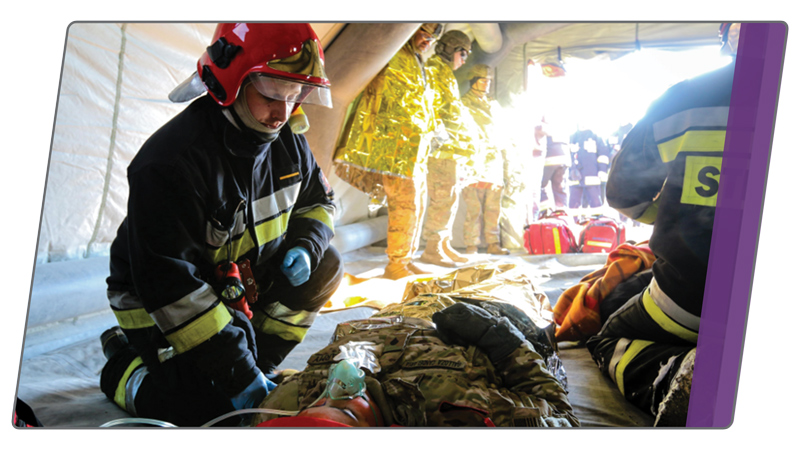
New scenarios let EMS, fire, EOD, and incident-command teams rehearse the coordination layer across venues that no live exercise can practically reach — surfacing the radio-handoff and staging failures classroom tabletops cannot teach.
Adaptive Immersion today announced the next release of MAVEN: RESPONDER, the company’s mass-casualty venue digital-twin platform, with new multi-agency coordination scenarios built around airfield, stadium, and large-event venues. The release lets EMS, fire, EOD, and incident-command teams rehearse the first thirty minutes of a multi-agency response — repeatedly, in instrumented form, with the radio environment and physical staging modeled to representative fidelity — at a cadence the budget for live joint exercises has historically prevented.
For most jurisdictions, joint multi-agency exercises happen once a year as a tabletop and once every three years as a full-scale field event. The doctrine is sound. The equipment is ready. The individual training is decent. But the coordination layer between agencies — who hands off to whom, on what frequency, at which staging area — is the layer most likely to fail in the first thirty minutes of an actual response, and it is the layer the calendar under-rehearses.
The MAVEN: RESPONDER release adds venue digital twins for representative open-air airfield demonstration venues, large-event stadium configurations, and mass-gathering concourses, paired with the existing multi-agency coordination scenarios. The dashboard captures four standard measurements automatically per run: time-to-first-action by agency, time-to-handoff at each agency-to-agency interface, radio-channel utilization in real time, and staging-area collision rate. These are the four metrics that distinguish a coordination-layer training program delivering measurable readiness from a joint-exercise ritual.
“The coordination layer is the most predictable failure mode in any multi-agency mass-casualty response, and it is the most preventable,” said Dr. Phillip M. Mangos, Chief Executive Officer of Adaptive Immersion. “The doctrine, the equipment, and the individual training are usually in place. What’s missing is the rehearsal frequency for the inter-agency handoff. The release closes that gap at a cost the training budget can actually carry.”
The platform anchors on the Adaptive Immersion Psychological Fidelity pillar. The training problem it addresses is not that responders lack technique — they do not. The problem is that the conditions of an actual mass-casualty response — sensory load, frequency saturation, ad-hoc team composition, casualty triage under uncertainty — cannot be reproduced in a conference-room tabletop and can be reproduced only sparingly in a live field exercise. Venue digital twins close the rehearsal-frequency gap that has historically prevented this layer from being trained as a measurable, repeatable, instrumented skill.
The release coincides with Adaptive Immersion’s LinkedIn Live session on Tuesday June 23, where Alejandro Arca, Ph.D., and Dr. Mangos will walk through the platform and demonstrate a multi-agency coordination scenario. The companion long-form analysis, “The First 30 Minutes,” examines the cascading-barrier pattern in mass-casualty response and the audit questions that distinguish coordination-layer readiness from ritual.