Independent Air Force Innovation Study Documents Major Cost and Readiness Gains from Adaptive Immersion’s Nuclear EOD VR Trainer
Independent Air Force Innovation Study Documents Major Cost and Readiness Gains from Adaptive Immersion’s Nuclear EOD VR Trainer
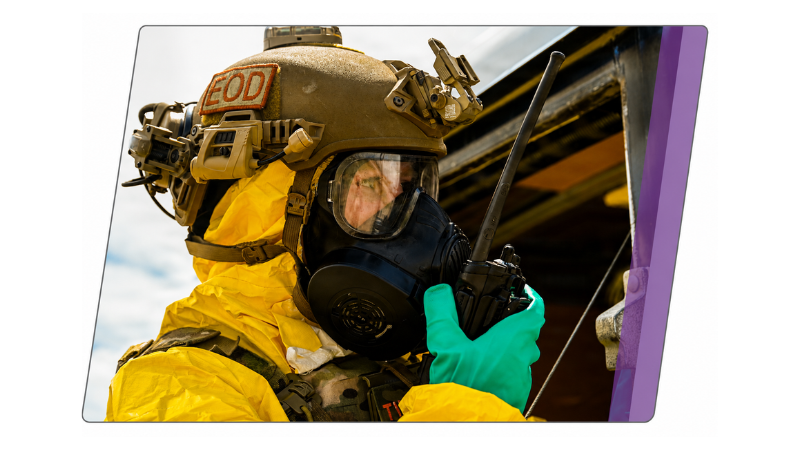
A third-party case study published by STRIKEWERX reports up to 94% lower training cost, near-total reductions in setup time, and several times more practice reps for Air Force nuclear explosive ordnance disposal teams.
An independent case study published by STRIKEWERX, the innovation hub of the Cyber Innovation Center (CIC), documents the outcomes of an Air Force Global Strike Command (AFGSC) effort to modernize how Airmen train for nuclear Explosive Ordnance Disposal (EOD) missions — and the numbers point to large, measurable gains. AFGSC adopted a virtual reality (VR) training system developed by Adaptive Immersion after a competitive evaluation, and the study reports cost reductions of up to 94 percent alongside a sharp increase in how often teams can practice the hardest scenarios they may ever face.
The technology emerged from a challenge event process headed by STRIKEWERX and AFGSC, a six-month market research and solution development campaign that brought together subject matter experts from industry, academia, and the military to define the problem before any vendor was chosen.
A nationwide call for solutions generated more than 100 ideas. Twenty-five companies were invited to showcase their concepts, eight submitted formal proposals, and three were selected to receive a combined $3 million to build and test prototypes across different scenarios. Adaptive Immersion’s game-based VR platform emerged from that field as the most promising solution.
The numbers: return on a readiness investment
The trainer places Airmen at a virtual aircraft crash site — arguably one of the most challenging nuclear EOD scenarios — and has them work through decisions under shifting conditions such as weather and time of day, while the system evaluates the same cognitive skills the real mission demands. STRIKEWERX measured the impact across two categories of units. The reported outcomes:
| Outcome measured | Nuclear Qualified units | Nuclear Certified units |
|---|---|---|
| Training repetitions per year | Increase from 1 → 8 | Increase from 12 → 33 |
| Setup time | 97% reduction | 98% reduction |
| Cost | 83% reduction | 94% reduction |
Source: STRIKEWERX case study, “Modernizing Nuclear EOD Training.”
Together, the increased training repetitions alongside the cost and setup numbers tell the real story. Simulating a downed aircraft in the physical world is labor- and time-intensive, available at only select locations, and limited in how many repetitions it can offer. Those constraints used to cap how much realistic practice Airmen could get. By cutting setup time by 97 to 98 percent and cost by 83 to 94 percent, the VR trainer turned a once-a-year training event into something teams can run many times over.
That shift matters most where it is hardest to get: low-frequency, high-consequence work. Nuclear EOD is exactly the kind of mission where the first real exposure should never be the first exposure. More reps, delivered affordably and on demand, mean newer operators can integrate faster and experienced ones can stay sharp — without waiting for a slot at a single distant facility.
Independent investment has followed
The validation has not stopped at the original study. The Defense Threat Reduction Agency has since committed more than $2 million in additional funding to support further software enhancements, and additional systems have been installed at five locations.
“This prototype has the potential to change how we train in EOD,” said retired U.S. Air Force Chief Master Sgt. Frank Pulice, the project champion, who is quoted in the study describing the work as navigating uncharted territory.
“Our goal is to provide a system so advanced that Airmen will not want to train without it, delivering millions of dollars in training cost savings,” said Dr. Phillip Mangos, President and Chief Scientist of Adaptive Immersion. “Working with STRIKEWERX on this project kept the focus on the most important stakeholder — the end user.”
The bottom line for training leaders
For teams responsible for dangerous, rarely-rehearsed missions, the question is rarely whether better training would help. It is whether the gains are real enough, and affordable enough, to change how often, how intensively, and how realistically people can practice. An independent evaluation here put numbers to that question: more repetitions, far less setup, and dramatically lower cost. That is the kind of evidence worth weighing when deciding how to prepare people for work where the first mistake can be the last.
The full case study, “Modernizing Nuclear EOD Training,” is published by STRIKEWERX and available at strikewerx.com.